 Home
Home


For further details, please contact us.
Contact Us
You're standing on the production floor, looking at a list of flexo press specifications that all seem to say the same thing—speed, color count, web width. Yet packaging engineers and production managers know that two presses with identical spec sheets can perform completely differently on the same job. The difference isn't in the numbers; it's in the architecture. CI, stack, and inline presses each solve a different set of production challenges, and choosing the wrong one is a mistake you'll live with for the entire operational life of the machine.
This guide breaks down the mechanical realities of each configuration—not to declare a winner, but to give you a decision framework that matches the architecture to your substrate, your runs, and your production floor.
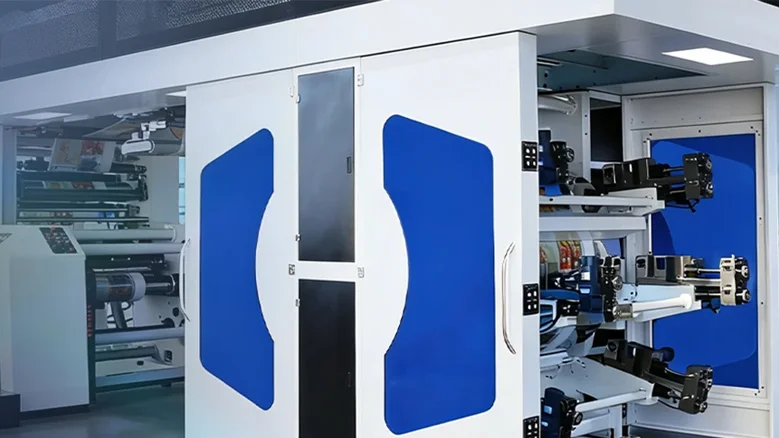
The Three Architectures: What They Are and Why They Exist
Every flexo press does the same basic job: meter ink through an anilox roller, transfer it to a plate cylinder, and press it onto a substrate against an impression cylinder. The difference lies in how the print stations are arranged and how the web travels between them.
Central Impression (CI) Flexo Press
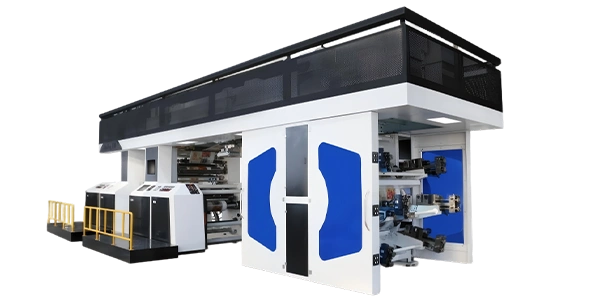
A CI press is built around a single, large-diameter central impression drum—often temperature-controlled to maintain stability. All print stations are arranged around this drum like satellites. The substrate wraps around the drum and never loses contact with it between color stations.
What this means for you: Because the substrate is physically supported by the drum through every color, there is virtually no web movement between stations. This is why CI presses deliver the tightest registration accuracy—typically ±0.075 mm to ±0.1 mm—making them the default choice for thin, stretchy films where even micron-level drift ruins the job.
CI presses typically offer 4 to 10 print stations, operate at web speeds of 100–300 m/min, and handle web widths commonly ranging from 1000 to 1800 mm in European and American markets. Common applications include printed pouches, snack bags, shrink sleeves, stick packs, sachets, lidding films, pet food bags, bottle labels, and overwraps.
Stack Flexo Press
A stack press arranges print units vertically, one above the other, with each station having its own impression roll. The web travels upward through the stack, passing from one color station to the next.
What this means for you: Each color station operates independently, which means you can change plates on a single deck without shutting down the entire machine. Stack presses have a more compact footprint—often just 4–6 meters in length—and significantly lower capital investment, typically in the $20K–$120K range. However, because each station has its own impression roll and the web is not continuously supported between stations, tension variation can affect registration on thin films. Web speeds typically range from 30–150 m/min, with modern servo-driven models reaching up to 250–300 m/min.
Inline (Unit-Type) Flexo Press
An inline press arranges print units horizontally in a straight line. Each station has its own impression point, and the web travels from one unit to the next with drying between.
What this means for you: The linear, modular design makes inline presses the champions of "print + convert in one pass". You can print, varnish, laminate, apply cold foil, die-cut, slit, and rewind—all without moving the job to another machine. This eliminates secondary passes and reduces both handling time and material waste. The trade-off is a larger footprint and higher complexity. Web speeds typically range from 50–200 m/min.
According to the Flexographic Technical Association (FTA), 88% of flexographic printing and converting plants rank maximizing efficiencies as their No. 1 priority. The choice of press architecture directly determines whether that efficiency is achievable on your specific substrate mix and run lengths.
CI vs Stack vs Inline
| Feature | CI Flexo Press | Stack Flexo Press | Inline Flexo Press |
| Layout | Stations around central drum | Stations stacked vertically | Stations in a horizontal line |
| Registration Accuracy | ±0.075–0.1 mm | ±0.2–0.5 mm | ±0.15–0.3 mm |
| Typical Web Speed | 100–300 m/min | 30–150 m/min | 50–200 m/min |
| Color Stations | 4–10 | 2–8 | 4–8 |
| Entry Investment | $150K–$800K+ | $20K–$120K | $80K–$400K |
| Substrate Sweet Spot | Thin films, laminates, foils | Paper, bags, non-woven, corrugated | Labels, cartons, folding carton |
| Best For | High-volume flexible packaging | Cost-effective, flexible runs | Integrated print+convert lines |
| Key Strength | Unmatched registration on stretch films | Compact footprint, lower cost | Inline finishing in one pass |
| Key Trade-off | Fixed stations are less operator-friendly for short runs | Tension variation affects thin-film registration | Larger footprint; higher complexity |
What the comparison tells you: CI is the precision specialist for film-based flexible packaging. Stack is the versatile workhorse for cost-sensitive operations on rigid or less stretch-sensitive substrates. Inline is the integration champion for operations where printing and converting need to happen in a single pass.
The Decision Framework: 5 Questions to Match Architecture to Your Line
Question 1: What substrate will you print on—and how thin is it?
This is the single most important question. Films under 25 microns (BOPP, PET, CPP) are prone to registration drift in stack presses at speed. If your primary substrate is thin, stretch-sensitive film, CI is the clear choice. If you're printing on paper, non-woven, corrugated, or bags, stack or inline may be perfectly adequate—and far more cost-effective.
As the Flexographic Technical Association notes, flexible packaging has historically been "primarily produced on a central impression (CI) press," while labels are "run on an inline press". This isn't tradition—it's physics. The substrate dictates the architecture.
Question 2: Do you need inline finishing—or can you finish offline?
If your operation requires die-cutting, laminating, foiling, or slitting as part of the same production pass, inline architecture is unmatched. Stack presses can connect to downstream converting equipment, but the integration is not as seamless as a purpose-built inline line. CI presses are primarily printing-focused; finishing typically happens offline.
Question 3: What are your typical run lengths?
For long, high-volume runs where setup time is amortized across millions of impressions, CI delivers the best speed and consistency. For shorter runs with frequent job changes, stack presses offer quicker single-deck changeovers without full machine shutdown, and inline presses excel at rapid job recall with modular design.
Question 4: What's your floor space and capital budget?
Stack presses have the smallest footprint—often 4–6 meters in length—and the lowest entry cost. CI presses, while more compact than inline in some configurations, require higher investment. Inline presses have the largest footprint and mid-range investment.
Question 5: Do you need front-and-back printing?
Stack presses can print both sides of the web in a single pass without turn bars, which is a significant advantage for tubing materials and applications requiring print on both sides. CI and inline presses can also achieve front-and-back printing, but typically require turn bars or additional configurations.
Quick decision guide:
| If your priority is... | Start with... |
| Registration accuracy on thin films | CI Flexo Press |
| Lowest capital investment and compact footprint | Stack Flexo Press |
| Inline finishing (die-cut, laminate, foil) in one pass | Inline Flexo Press |
| Front-and-back printing without turn bars | Stack Flexo Press |
| High-volume, long-run flexible packaging | CI Flexo Press |
| Labels, folding carton, and modular convertibility | Inline Flexo Press |
Real-World Application Scenarios
Scenario A: Flexible packaging converter—pouches, snack bags, shrink sleeves
A converter produces printed pouches for the food industry. The primary substrates are BOPP, PET, and laminated films. Run lengths are long—typically 500,000+ impressions per job. Color consistency across the run is critical for brand compliance.
-
Recommended architecture: CI flexo press
-
Why: The central impression drum keeps the substrate fully supported through every color station, delivering the ±0.075 mm registration that thin films demand. High speeds (up to 300 m/min) maximize throughput on long runs.
-
What to verify: Confirm the press has temperature-controlled drum and closed-loop tension control for heat-sensitive films.
Scenario B: Label and carton producer—short runs, frequent changeovers
A label converter handles 50–100 different SKUs per week, with run lengths ranging from 5,000 to 50,000 impressions. Many jobs require inline die-cutting and slitting. The operation needs to minimize setup waste and changeover time.
-
Recommended architecture: Inline flexo press
-
Why: Modular design allows quick addition of die-cutting, foiling, and slitting units. Automated job recall and quick-change features enable seamless transitions between jobs.
-
What to verify: Look for servo-driven systems with fast job recall and minimal setup waste.
Scenario C: Medium-sized packaging plant—mixed substrates, cost-conscious
A packaging plant prints on paper, non-woven, and bags—but not thin films. The operation runs a mix of short and medium runs. Floor space is limited, and capital is constrained.
-
Recommended architecture: Stack flexo press
-
Why: Compact footprint (4–6 meters) and lower entry cost fit the budget. The ability to use water-based inks and operate quietly makes it environmentally friendly. Front-and-back printing in one pass adds versatility.
-
What to verify: For non-woven and paper applications, stack press registration (±0.2–0.5 mm) is more than sufficient. Confirm the press can connect to downstream converting equipment if needed.
For detailed specifications across different press configurations and substrate capabilities, explore the CI flexo printing machines series available for various production volumes and material types.
The Quality Dimension: ProcessStandard Flexo and What It Means for Your Choice
In 2025, Fogra—the German research institute for printing and media technology—introduced ProcessStandard Flexo (PSF), the first industry-wide certification standard specifically for flexographic printing. The PSF establishes clearly defined guidelines and tolerances, using a measurable "fingerprint" reference for each printing condition rather than prescribing fixed targets for all circumstances.
Why this matters for your press selection: PSF certification demonstrates that a print shop can deliver consistent, color-accurate results. But the foundation of that consistency starts with the press architecture.
-
CI presses are inherently easier to bring into PSF compliance for film substrates because the central drum eliminates a primary source of registration variation.
-
Stack presses can achieve PSF certification for paper and non-woven applications, where the ±0.2–0.5 mm registration tolerance is acceptable, but thin films will struggle to meet PSF tolerances.
-
Inline presses with servo drives and advanced registration controls can achieve PSF-level consistency for labels and cartons.
The PSF guidelines are "scientifically sound and reflect the current state of the art"—and crucially, "aligned with real-world conditions in printing companies". When evaluating a press, ask the manufacturer: "Can this press configuration consistently reproduce a PSF fingerprint within tolerance on my primary substrates?"
For industry-specific guidance on color-accurate, process-controlled flexo production across different packaging applications, refer to the solutions page for flexible packaging, labels, and converting operations.
Next Steps: From Architecture to Equipment Selection
By now, you should have a clear framework for evaluating which press architecture aligns with your production reality: substrate type and thickness, need for inline finishing, typical run lengths, floor space, and capital constraints.
The next logical step is moving from architecture selection to specific equipment evaluation. Key questions to ask any supplier:
-
What is the registration accuracy on my specific substrate? Ask for sample print runs with your materials.
-
What is the actual setup waste and changeover time? Modern servo-driven stack presses can achieve setup waste as low as about 30 feet.
-
What tension control systems are in place? For thin films, closed-loop tension control with real-time communication (e.g., PROFINET IRT) is critical.
-
What is the total cost of ownership—not just purchase price? Consider energy consumption, maintenance, and material waste.
Review the flexo printing machine series to compare configurations across CI, stack, and inline architectures. For project-specific technical consultation on press selection and line integration, the service and support team can provide substrate-specific guidance and run feasibility assessments.
Related Reading
-
How to Choose the Right Flexo Press for Food Packaging Applications
-
Flexo Press Registration Accuracy: What the Spec Sheet Doesn't Tell You
-
Substrate Compatibility Guide for CI, Stack, and Inline Flexo Presses
-
Total Cost of Ownership: Comparing Flexo Press Architectures
-
ProcessStandard Flexo (PSF): What Converters Need to Know