

 Home
Home


For further details, please contact us.
Contact Us
You're printing packaging that will hold food—snack bags, frozen food pouches, bakery boxes, or ready-to-eat meal trays. The printing press you choose isn't just about speed and color count. It's about safety. The ink on the outside of a package can migrate through the substrate and into the food. The wrong press configuration can compromise drying, trap solvents, or fail to maintain the registration needed for clear allergen labeling.
Food packaging converters face a unique challenge: balancing production efficiency with regulatory compliance across multiple markets. The FDA in the United States, the European Food Safety Authority (EFSA) in the EU, and national standards like China's GB 9685-2016 each impose different requirements on printing inks and food-contact materials.
This guide walks you through the technical decisions—from press architecture to ink systems to quality control—that determine whether your food packaging prints safely, consistently, and compliantly.
Regulatory Compliance: The Non-Negotiable Foundation
Before comparing press specifications, understand the regulatory landscape. Food packaging printing is governed by different frameworks depending on where your product will be sold.
United States – FDA 21 CFR
The FDA regulates packaging materials that come into direct or indirect contact with food. Printing inks that are reasonably expected to migrate to food must be cleared by the FDA and be subject to safety, compliance, and migration assessments. Key regulatory references include:
-
21 CFR Part 175: Indirect food additives – adhesives and coating components
-
21 CFR Part 176: Paper and paperboard components
-
21 CFR Part 178: Indirect food additives – adjuvants, production aids, and sanitizers
The FDA maintains an Inventory of Effective Food Contact Substance (FCS) Notifications. For paper and paperboard in contact with aqueous and fatty foods, extractable limits apply per the specific food type and temperature conditions defined in the regulation.
European Union – EU 10/2011 and Beyond
The EU framework is more documentation-intensive. Under Regulation (EU) 10/2011, every substance in the ink that may migrate must be on the Union positive list. The overall migration limit (OML) is 10 mg/dm² or 60 kg food simulant. Specific migration limits (SML) apply to individual regulated substances—for example, the benzophenone photoinitiator carries a specific migration limit of 0.6 mg/kg under EFSA guidance.
The Council of Europe Resolution AP(2005)2 on printing inks, alongside national implementations such as the Swiss Ordinance SR 817.023.21, provides additional operational guidance. The European Commission is currently evaluating the EU legislation on Food Contact Materials, with a draft specific measure for printing inks under development.
China – GB 9685-2016
China uses a positive list model similar to the EU but with different permitted substances and limits. GB 9685-2016, the national food safety standard for additives used in food contact materials and products, adopts a positive list approach. The standard's Appendix A lists permitted additives by material category—Table A.4 specifically covers additives allowed in printing inks—providing the regulatory basis for ink formulation review. For food packaging printed in China or exported to the Chinese market, ink formulations must be cross-referenced against the GB 9685 positive list.
What This Means for Press Selection
The press itself doesn't make the package compliant—the ink and substrate do. But the press enables compliance. A press with poor drying control can leave residual solvents above the 5 mg/dm² threshold for most food-contact applications. A press with inconsistent tension can cause set-off (ink transferring from the printed side to the unprinted side during rewinding), creating an indirect migration path. A press without precise temperature control on the drying system can fail to fully cure UV inks, leaving photoinitiators that may migrate into food.
FDA regulations consider printing inks as potential indirect food additives that must comply with the requirements of the indirect food additive guidelines when they are reasonably expected to migrate to food.
For an overview of press configurations that support different food packaging applications, explore the flexo printing machine series.
Press Architecture and Food Packaging Substrates
Food packaging spans a wide range of substrates—each with different requirements for the press architecture.
Flexible Films (BOPP, PET, PE, Laminates)
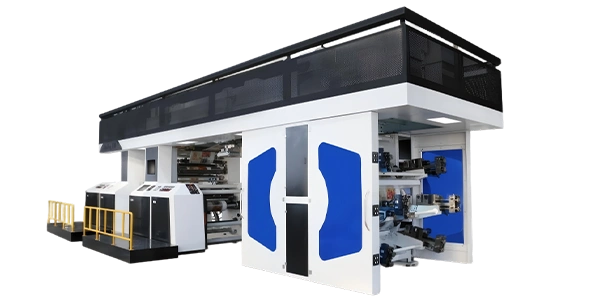
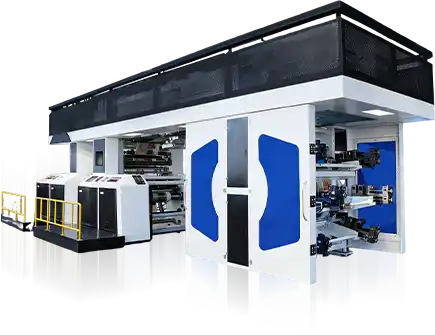
Thin, stretch-sensitive films are the dominant substrate for snack bags, frozen food pouches, and shrink sleeves. These materials require CI flexo printing machines. The large central impression drum supports the substrate continuously through all color stations, delivering the ±0.075 mm registration accuracy that thin films demand. This precision is critical for brand logos, nutritional panels, and allergen warnings that must remain legible at small font sizes.
Paper and Paperboard
For folding cartons, bakery boxes, and dry food packaging, both stack and inline flexo presses are viable. Stack presses offer a compact footprint and lower capital investment—suitable for paper bags and simple wraps. Inline presses excel at single-pass production with integrated die-cutting and creasing, making them the natural choice for folding cartons where printing, varnishing, and finishing happen in one pass.
Labels
Pressure-sensitive labels for food products are predominantly printed on inline flexo printing machines. The modular design allows addition of die-cutting, laminating, and slitting units, enabling a finished label roll to emerge from the press in a single pass.
Key Decision Factor: Match the press architecture to your primary substrate first. If you're primarily printing thin films, CI is the clear choice. If you're printing paperboard with inline finishing requirements, inline flexo is the better fit. If you're printing simple paper bags with limited finishing, stack flexo may be the most cost-effective option.
For substrate-specific guidance across different packaging applications, refer to the flexo printing solutions page.
Ink Systems and Press Compatibility
Food packaging inks fall into three main categories, each with different press requirements.
| Ink Type | Key Feature | Press Requirement | Best For |
|---|---|---|---|
| Water-based inks | Low migration potential, low VOC | Efficient drying system; absorbent substrates | Paper, paperboard, some films |
| UV-curable inks | Fast curing, high durability | UV curing units on each color station | Films, labels, non-absorbent substrates |
| Solvent-based inks | Strong adhesion, excellent print quality | Solvent recovery system; ventilation | Films, flexible packaging |
Water-based inks are the most common choice for food packaging on paper and paperboard. They offer lower migration potential and environmental impact. However, they require efficient drying systems—insufficient drying leads to set-off and smudging. On a press, this means adequate dryer capacity (hot air or infrared) and proper web path length for drying between stations.
UV-curable inks are increasingly popular for food packaging on films and non-absorbent substrates. They cure instantly under UV light, enabling higher speeds and eliminating solvent evaporation issues. But the press must be equipped with UV curing units at each color station. Critically, under-cured UV ink is the single most common cause of photoinitiator migration—so press UV system maintenance and energy monitoring are non-negotiable.
Solvent-based inks provide excellent adhesion and print quality but require solvent recovery systems and ventilation. They are less common in new food packaging installations due to environmental and regulatory pressures.
What to Verify With Any Press Supplier:
-
Does the press support the ink type(s) you plan to use?
-
What is the drying/curing capacity at maximum speed?
-
Are drying temperatures controllable to avoid substrate damage?
-
For UV systems: what is the energy output and how is it monitored?
Quality Control Systems for Food Packaging
Food packaging printing demands consistent quality—not just for brand appearance, but for regulatory compliance. The press's quality control systems directly affect your ability to meet food safety requirements.
Registration Control
Misregistration creates blurry text—particularly problematic for nutritional panels and ingredient lists that must be legible at small sizes. Modern servo-driven presses achieve registration accuracy of ±0.075 mm to ±0.1 mm. For food packaging, this precision isn't just aesthetic; it's a regulatory requirement in many markets.
Color Management and ProcessStandard Flexo (PSF)
In 2025, Fogra—the German research institute for printing and media technology—introduced ProcessStandard Flexo (PSF), the first industry-wide certification standard specifically for flexographic printing. The standard aims to streamline production processes and enable reliable color communication between printers and clients.
"Our goal is to make flexographic print quality measurable and to simplify communication between clients, repro houses, and printers." — Jürgen Gemeinhardt, Head of Printing Techniques, Fogra
The PSF uses a fingerprint as an individual reference throughout the entire workflow, determining the target values to be achieved in proof printing and production printing. Certification lasts for two years and requires a production run of a Fogra test form to determine adherence to the standard.
Why PSF Matters for Food Packaging: The PSF has been developed to take account of the diverse requirements of packaging where printing inks can be selected not just for their colour properties but also according to other criteria, such as light fastness. For food packaging, where ink selection is already constrained by regulatory compliance, having a standardized quality framework helps ensure consistent results across production runs.
Drying and Curing Monitoring
Ink migration is fundamentally a function of incomplete drying or curing. A press with real-time drying temperature monitoring and UV energy measurement provides critical data for compliance documentation. When an auditor asks for evidence that your process prevents migration, temperature and energy logs from the press become part of your compliance file.
Vision Inspection Systems
Inline vision inspection systems—cameras that scan every printed impression for defects—are increasingly standard on food packaging presses. They catch hickeys, streaks, and registration errors before they reach the customer. For food packaging, where a single defective batch can trigger a recall, this capability is insurance against brand damage.
For detailed technical support on press configuration and quality control systems, the service and support team can provide application-specific guidance.
Real-World Application Scenarios
Scenario A: Flexible packaging converter—snack bags and pouches
A converter produces printed pouches for the snack food industry. Substrates are primarily BOPP, PET, and laminated films. Run lengths are long—500,000+ impressions per job. The operation exports to both the US and EU markets.
-
Recommended press architecture: CI flexo press with 6–8 color stations
-
Why: Central impression drum delivers the ±0.075 mm registration that thin films demand. Multiple color stations support brand colors plus spot colors for promotional packaging.
-
Critical press features: Temperature-controlled impression drum for film stability; UV curing units for film substrates; closed-loop tension control; real-time drying temperature monitoring for compliance documentation
-
Compliance consideration: Press must support both FDA-compliant and EU-compliant ink systems—meaning easy anilox roller changeover and cleaning between ink types
Scenario B: Folding carton producer—pharmaceutical and food boxes
A converter produces folding cartons for pharmaceuticals and premium food products. Each job requires 4–6 colors, fine detail, varnishing, die-cutting, and creasing. The operation processes 50+ SKUs per month.
-
Recommended press architecture: Inline flexo press with integrated finishing modules
-
Why: Single-pass production eliminates handling and work-in-progress. Inline die-cutting and creasing deliver finished cartons directly from the press.
-
Critical press features: Modular design for finishing integration; ±0.05 mm registration for fine type on pharmaceutical labels; automated job recall for frequent changeovers
-
Compliance consideration: Water-based inks on paperboard; press drying system must be capable of full drying at production speeds to prevent set-off
Scenario C: Paper bag manufacturer—food service and retail
A converter produces paper bags for food service (restaurant takeout, bakery) and retail. Orders range from 10,000 to 100,000 units. Most jobs require 1–4 colors, simple graphics, and double-sided printing.
-
Recommended press architecture: Stack flexo press
-
Why: Compact footprint fits limited space. Lower capital investment aligns with budget. Double-sided printing is straightforward with turnover rollers.
-
Critical press features: Quick changeover for short runs; adequate drying for water-based inks on absorbent paper
-
Compliance consideration: FDA-compliant inks for food-contact paper; press must not introduce contaminants during printing
Next Steps – From Requirements to Equipment Evaluation
By now, you should have a clear framework for evaluating flexo presses for food packaging applications:
-
Regulatory requirements — Which markets are you selling into? FDA, EU, China, or multiple?
-
Primary substrate — Thin films, paperboard, labels, or paper bags? This determines CI, inline, or stack architecture.
-
Ink system — Water-based, UV-curable, or solvent-based? This determines drying/curing requirements.
-
Quality control — Registration accuracy, color management (PSF), vision inspection, and drying monitoring.
-
Finishing needs — Does the press need integrated die-cutting, creasing, or slitting?
The next logical step is moving from requirements to specific equipment evaluation. Key questions to ask any press supplier for food packaging applications:
-
What is the registration accuracy on my specific food packaging substrates? Ask for sample print runs with your materials.
-
What drying/curing systems are available—and what is the energy output at maximum speed? Under-cured ink is the leading cause of migration failures.
-
How does the press support compliance documentation? Can the press provide temperature logs, UV energy records, and production data for audit purposes?
-
What is the changeover time between ink systems? If you switch between water-based and UV inks, cleaning and setup time affects production efficiency.
-
Is the press compatible with low-migration ink systems? Not all presses handle the viscosity and curing requirements of low-migration formulations.
Review the flexo printing machine series to compare configurations across CI, stack, and inline architectures for food packaging applications. For project-specific technical consultation on press selection and regulatory compliance, the service and support team can provide substrate-specific guidance and compliance assessments. Submit your project details to book a free one-on-one technical consultation.
Related Reading
-
FDA and EU Compliance Guide for Food Packaging Printing
-
Substrate Selection for Food-Contact Flexographic Printing
-
CI vs Stack vs Inline Flexo Presses: Which Fits Your Production Line?
-
Low-Migration Inks for Food Packaging: A Converter's Guide
-
ProcessStandard Flexo (PSF): What Food Packaging Converters Need to Know