 Home
Home


For further details, please contact us.
Contact Us
You’re printing paper bags, folding cartons, or food‑grade paper packaging—and you’ve narrowed down the press options to two architectures: stack flexo and inline flexo. Both print on paper. Both deliver acceptable quality for most paper substrates. But they are fundamentally different machines designed for fundamentally different production philosophies.
One is built for simplicity and space efficiency—compact, cost‑effective, and surprisingly versatile for certain paper applications. The other is built for integration—a modular production line that turns a roll of paper into a finished, die‑cut, folded box in a single pass.
Choosing the wrong flexo press means overpaying for unnecessary features or — worse — finding out late that your equipment cannot fulfill your order specifications. This guide clarifies the practical differences between stack flexo printing machines and inline flexo printing machines, allowing you to select the optimal mechanical layout based on your substrate mix, run lengths, and post-print finishing demands.
Understanding the Two Architectures
Stack Flexo Press
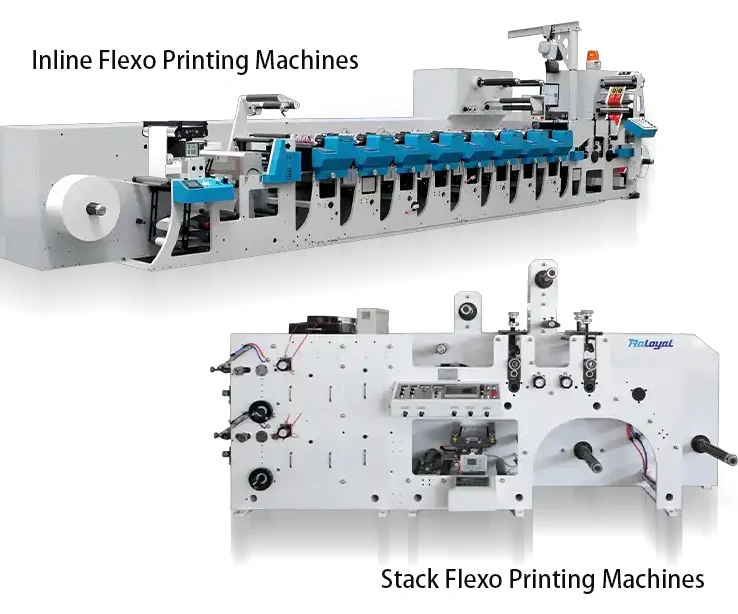
A stack flexo press—also called a stacked‑type or cascading flexo press—arranges printing units vertically, one stacked above the other. Each unit has its own impression cylinder, plate cylinder, and inking system. The paper web travels upward through the stack, passing from one colour station to the next.
Key characteristics:
-
Compact footprint: Typically occupies only about 40% of the floor space of an inline press
-
Lower capital investment: Generally the most affordable flexo press architecture
-
2–8 colour stations: Typically supports up to 8 colours
-
Registration accuracy: Generally ±0.1 mm
-
Web speeds: Typically 30–150 m/min, with modern servo‑driven models reaching higher speeds
Inline Flexo Press
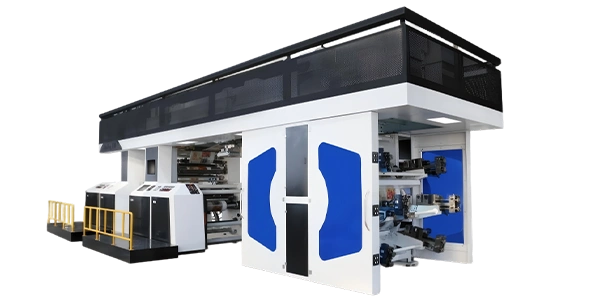
An inline flexo press—also called a unit‑type flexo press—arranges printing units in a straight horizontal line. Each unit is independent and modular. The paper web travels in a continuous path from one station to the next, and additional converting modules can be added along the line.
Key characteristics:
-
Modular design: Can be configured with 1–12 or more printing units
-
Integrated finishing: Supports inline die‑cutting, lamination, foiling, slitting, and more
-
Higher registration accuracy: Typically ±0.05 mm with electronic shaft drive
-
Web speeds: Typically 50–200 m/min, with some models exceeding 300 m/min
-
Wider substrate range: Handles paper, films, folding carton, and specialty packaging
Side‑by‑Side Comparison: Stack vs Inline Flexo for Paper Packaging
| Feature | Stack Flexo Press | Inline Flexo Press |
|---|---|---|
| Layout | Units stacked vertically | Units arranged in a horizontal line |
| Registration Accuracy | ±0.1 mm | ±0.05 mm |
| Typical Web Speed | 30–150 m/min | 50–200+ m/min |
| Colour Stations | 2–8 | 1–12+ |
| Floor Space | ~40% of inline footprint | Larger footprint |
| Capital Investment | Lower | Higher |
| Inline Finishing | Limited | Extensive (die‑cut, laminate, foil, slit) |
| Double‑Sided Printing | Easy with turnover rollers | Possible with turn bars, more complex |
| Best For | Paper bags, shopping bags, simple packaging | Folding cartons, labels, complex packaging |
| Key Strength | Cost‑effective, compact, simple operation | Single‑pass finished product |
| Key Trade‑off | Lower precision, limited inline finishing | Higher cost, larger footprint |
According to industry data, inline flexo presses serve as the mainstay for packaging printing due to their flexibility and versatility, while stack presses maintain a cost advantage in printing rigid materials like paperboard.
The Decision Framework – 5 Questions for Paper Packaging Converters
Question 1: What type of paper packaging do you produce—and what comes after printing?
If you’re printing paper bags, shopping bags, or simple food wraps where the only post‑printing step is rewinding or basic slitting, stack flexo may be entirely sufficient—and far more cost‑effective.
If you’re producing folding cartons, pharmaceutical boxes, or premium packaging that require die‑cutting, creasing, varnishing, or foiling, inline flexo is the clear choice. Single‑pass inline flexo production integrates printing, varnishing, die‑cutting, and stripping into one continuous process. This eliminates the work‑in‑progress and multiple handling steps associated with offline finishing.
Question 2: What’s your average run length?
Stack flexo presses are well‑suited for short‑ to medium‑run printing applications. They enable quick job changes and can accommodate various web widths. The simpler setup and lower cost per machine hour make stack presses economical when you’re running many different jobs with frequent changeovers.
Inline flexo presses excel at medium to long runs where the investment in setup and integration is amortised across higher volumes. However, modern inline presses with servo drives and job recall features are increasingly competitive for shorter runs as well.
Question 3: How much floor space do you have—and what’s your budget?
Stack flexo presses occupy significantly less floor space—roughly 40% of what an inline press requires. They also represent a lower capital investment. For a growing converter with limited space and capital, stack flexo offers a lower barrier to entry.
Inline flexo presses require more floor space and a higher upfront investment, but they consolidate multiple production steps into one machine—potentially eliminating the need for separate die‑cutting or finishing equipment.
Question 4: Do you need double‑sided printing?
Stack flexo presses can print both sides of the web in a single pass using turnover rollers. This is a significant advantage for applications like paper bags that require printing on both the front and back.
Inline flexo presses can also achieve double‑sided printing, but typically require turn bars or more complex web path configurations. If double‑sided printing is a core requirement, stack flexo has a natural advantage.
Question 5: What’s your quality target?
For simple, large‑area graphics and text on paper, stack flexo’s ±0.1 mm registration accuracy is perfectly adequate. For fine details, small type, or intricate brand logos—particularly on coated papers or carton board—inline flexo’s ±0.05 mm accuracy delivers sharper results.
Quick decision guide:
| If your priority is... | Recommended architecture |
|---|---|
| Lowest capital investment and compact footprint | Stack Flexo Press |
| Single‑pass finished product (die‑cut, creased, varnished) | Inline Flexo Press |
| Double‑sided printing without complex web paths | Stack Flexo Press |
| High‑quality fine detail and tight registration | Inline Flexo Press |
| Paper bags, shopping bags, simple wraps | Stack Flexo Press |
| Folding cartons, pharmaceutical boxes, premium packaging | Inline Flexo Press |
Real‑World Application Scenarios
Scenario A: Paper bag manufacturer – high mix, cost‑conscious
A converter produces shopping bags and food bags for retail clients. Orders range from 10,000 to 100,000 units per job. Most jobs require 1–4 colours, simple graphics, and double‑sided printing. Floor space is limited, and capital is constrained.
-
Recommended architecture: Stack flexo press
-
Why: The compact footprint fits the space. The lower investment aligns with the budget. Double‑sided printing is straightforward. The ±0.1 mm registration accuracy is more than sufficient for simple bag graphics. Quick changeovers support the high‑mix order pattern.
-
What to verify: Confirm the press can handle your specific paper grades and grammages. Verify that the drying system matches your production speed.
Scenario B: Folding carton producer – premium packaging, single‑pass production
A converter produces folding cartons for cosmetics, pharmaceuticals, and food. Each job requires 4–6 colours, fine detail, varnishing, die‑cutting, and creasing—all in one finished product. The operation processes 50+ SKUs per month with medium run lengths.
-
Recommended architecture: Inline flexo press
-
Why: Single‑pass production eliminates handling and work‑in‑progress. The ±0.05 mm registration accuracy delivers the fine detail that premium brands demand. Modular design allows integration of die‑cutting, varnishing, and foiling units. The inline workflow reduces production time significantly—one comparison showed inline flexo production at 222 minutes versus 407 minutes for an equivalent litho job.
-
What to verify: Confirm the press can handle your carton board caliper range. Evaluate the makeready waste and changeover time for your typical job mix.
For detailed specifications across different press configurations—including stack, inline, and CI architectures—explore the flexo printing machine series designed for various paper packaging applications and production volumes.
Paper Substrate Considerations
Not all paper is the same—and different paper grades interact differently with each press architecture.
-
Uncoated paper (e.g., kraft): Highly absorbent, forgiving on registration. Stack flexo’s ±0.1 mm accuracy is generally sufficient. Inline flexo offers higher precision but may be overkill for simple kraft applications.
-
Coated paper (art paper, cast‑coated): Smoother surface, less absorbent. Requires precise ink transfer and drying control. Inline flexo’s tighter registration and better drying integration offer advantages for high‑quality coated paper printing.
-
Paperboard/carton board (200–400 gsm): Stiffer, less prone to web wandering. Both stack and inline can handle paperboard. However, inline’s integrated die‑cutting and creasing capabilities make it the natural choice for folding carton production.
-
Greaseproof paper (for food packaging): Lightweight (30–60 gsm), prone to stretching. Stack flexo’s tension control becomes critical—excessive tension can cause elongation and registration drift. Inline flexo with advanced tension control may offer better stability for lightweight papers.
Flexible packaging is primarily produced on central impression (CI) presses, whereas labels are run on inline presses. For paper packaging, however, both stack and inline are viable—the choice depends on your specific finishing requirements and quality targets.
Next Steps – From Architecture to Equipment Selection
By now, you should have a clear framework for evaluating whether stack or inline flexo better serves your paper packaging operation: substrate type and grammage, need for inline finishing (die‑cutting, creasing, varnishing), typical run lengths, floor space, and capital constraints.
The next logical step is moving from architecture selection to specific equipment evaluation. Key questions to ask any supplier:
-
What is the registration accuracy on my specific paper grades? Ask for sample print runs with your materials.
-
What inline finishing modules are available—and what’s the changeover time? For inline presses, verify that die‑cutting, creasing, and varnishing can be integrated seamlessly.
-
What tension control systems are in place for lightweight papers? For greaseproof or thin kraft papers, closed‑loop tension control is critical.
-
What is the total cost of ownership—not just purchase price? Consider energy consumption, maintenance, material waste, and the cost of separate finishing equipment if you choose stack over inline.
Review our full flexo printing machine lineup to compare layouts of stack and inline flexo presses for flexible packaging, label, paper, and dairy production. If you need custom technical support including substrate matching testing and production run feasibility evaluation for diverse packaging projects, our professional technical team provides targeted solutions. Explore full machine ranges and real-world application cases covering all packaging sectors on our Raloyal packaging industry solutions page.
Related Reading
-
How to Choose the Right Flexo Press for Food Packaging Applications
-
Paper Substrate Selection Guide for Flexographic Printing
-
CI vs Stack vs Inline Flexo Presses: Which Fits Your Production Line?
-
Folding Carton Printing with Inline Flexo: A Converter’s Guide
-
Paper Bag Printing: Stack Flexo vs CI Flexo Compared