

 Home
Home


For further details, please contact us.
Contact Us
In the $358.5 billion global packaging printing sector, flexography and rotogravure stand as the two dominant industrial printing technologies. For decades, gravure was synonymous with premium graphic reproduction and ultra-long production runs, while flexography was positioned as a cost-effective workhorse for basic packaging applications. Today, this long-standing industry paradigm has been fundamentally reshaped. According to Smithers data published by Labels & Labeling, flexography holds the largest market share in the combined packaging print landscape as of 2026, and the competitive dynamic continues to evolve as digital automation, plate-making technology, and ink chemistry redefine the performance boundaries of each process.
For converters and brand owners evaluating optimal printing technology for flexible packaging operations, selection hinges on production run lengths, substrate compatibility, sustainability targets, and total cost of ownership. This analysis provides a systematic comparison across core performance dimensions, drawing on technical insights from leading press manufacturers, industry publications, and global market research.
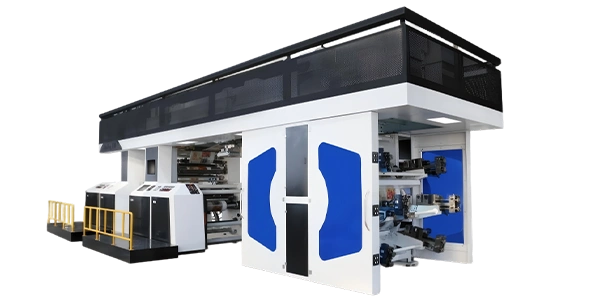
To match your unique production parameters with proven flexo hardware built for modern packaging workflows, explore Raloyal's complete range of flexo presses.
Core Technologies: Fundamental Working Principles
Rotogravure Printing
Gravure is an intaglio printing process where graphic patterns are directly engraved onto copper-plated steel cylinders. During production, ink fills the engraved cells on the cylinder surface, a precision doctor blade uniformly removes excess ink from non-image areas, and the substrate passes through the nip between the gravure cylinder and impression roller to transfer ink under high line pressure. This direct transfer mechanism delivers exceptional ink laydown consistency, precise halftone reproduction, and stable print quality across extremely long runs without performance degradation.
Historically the gold standard for high-volume publication and flexible packaging printing, gravure maintains strong dominance in Asian markets, supporting a projected 3.6% volume CAGR through 2030.
Flexographic Printing
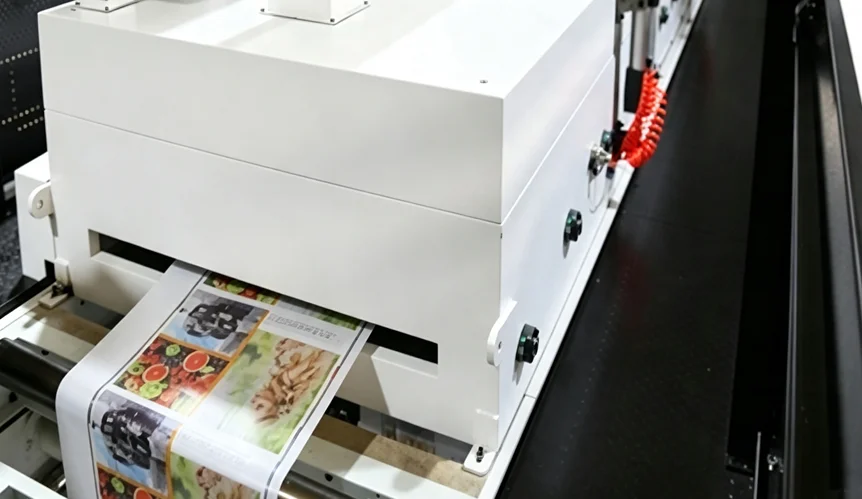
Flexography is a relief printing process that uses photopolymer plates mounted on print cylinders. Ink is metered onto the plate surface with high precision via anilox rollers with calibrated micro-engraved cells, then transferred directly to the substrate. Modern central impression (CI) flexo presses feature a large-diameter central drum that maintains precise substrate registration across all printing units, while inline configurations offer superior versatility for integrated converting processes.
Over the past decade, flexographic technology has undergone transformative upgrades. As noted in Drupa industry analysis, digital advances in plate fabrication, ink delivery control and press automation have fundamentally overhauled the process capability of flexography. What was once regarded as a coarse, low-resolution method now delivers gravure-comparable quality for most packaging applications, with greater operational flexibility.
Head-to-Head Technical & Operational Comparison
Print Quality and Graphic Reproduction
Gravure's core competitive advantage remains its print quality performance. Its direct cylinder-to-substrate transfer delivers seamless vignette transitions, uniform solid ink density, and ultra-fine detail reproduction. For applications requiring photographic-grade imagery, micro-text legibility, or absolute brand color consistency across millions of impressions, gravure remains the industry benchmark.
Yet the historical quality gap has narrowed sharply. Modern flexo presses, equipped with high-definition digital photopolymer plates, advanced anilox engraving technology and servo-driven registration systems, achieve 150–175 lpi screen rulings with tightly controlled dot gain. Leading flexo manufacturers use monoblock unit architecture to minimize mechanical tolerances across the press, delivering predictable, repeatable quality that meets gravure-equivalent standards for the vast majority of flexible packaging applications. Hybrid configurations combining flexographic units with digital inkjet and offset modules further extend production versatility while preserving premium output.
Cost Structure and Production Economics
The two technologies have fundamentally different economic profiles and operating cost structures, creating a clear volume-based break-even threshold tied directly to production scale and job mix diversity.
Gravure production relies on engraved steel cylinders manufactured via multi-stage plating and engraving workflows, resulting in significant fixed tooling investment per job and multi-day production lead times. Cylinders also require dedicated storage infrastructure, periodic maintenance and re-engraving services over their operational lifecycle, adding sustained operational overhead. For converters with a high mix of artwork designs and frequent version changes, these tooling costs and lead times represent a material operational and financial burden.
Flexography uses photopolymer plates fabricated via digital computer-to-plate (CtP) systems, with a far more streamlined workflow. Per-job tooling requires only a fraction of the upfront investment of gravure cylinders, and plates can typically be produced in-house or sourced locally with short turnaround windows. This low tooling barrier is one of the most defining economic advantages of flexography, especially for operations managing a broad portfolio of SKUs and variable run lengths.
In unit production economics, gravure delivers the strongest cost performance only at very high sustained volumes, where fixed cylinder costs are amortized across millions of impressions. For short- to medium-run jobs, however, flexography holds a clear advantage: lower tooling means jobs reach break-even profitability at far lower volumes, and modern automated presses drastically reduce setup waste. This aligns directly with today's prevailing market trend of SKU proliferation, shorter product lifecycles and fast turnaround demands.
Substrate Compatibility and Versatility
Flexography holds a distinct advantage in substrate compatibility and application versatility. Its resilient elastomeric photopolymer plates conform to irregular substrate surfaces, making it suitable for materials ranging from ultra-thin flexible films to corrugated board, paper, plastic, foil and textured specialty materials. Leading flexo press platforms support UV, UV-LED, water-based and solvent-based inks on a single machine, covering applications from thin shrink sleeves to heavy-duty lidding stock and structural packaging films.
Gravure performs optimally on smooth, coated substrates where its high-pressure nip transfer delivers the best results. It presents limitations on textured or uneven surfaces, and requires substrates with sufficient dimensional stability to withstand high web tension and nip pressure. While it can process many common film substrates effectively, its applicable material range is narrower than that of flexography across the full packaging spectrum.
Sustainability and Environmental Performance
As regulatory pressure intensifies and brand owners elevate their ESG targets, sustainability has become a core decision-making criterion for printing technology selection — and in this dimension, flexography holds growing structural advantages.
Modern flexography has largely transitioned from solvent-based to water-based and UV-curable ink systems, dramatically reducing volatile organic compound (VOC) emissions. Leading press manufacturers report that automated flexo production solutions generate less material waste, require fewer unplanned production interruptions, and lower energy intensity across the production workflow.
Gravure, historically reliant on high-solvent ink formulations, has also improved its environmental profile through solvent recovery systems and next-generation ink chemistries. However, the fundamental process chemistry of gravure, combined with higher energy requirements for drying and cylinder handling, results in a higher overall environmental footprint compared to modern flexographic systems.
Changeover Efficiency and Production Agility
Amid the industry-wide shift toward high-mix, low-volume production, job changeover efficiency has emerged as a pivotal operational KPI.
Flexographic plate changes require only minutes per printing unit, and fully automated plate change and auto-registration systems can complete a full job changeover in less than one hour with minimal manual intervention. Advanced closed-loop color management systems achieve target color specifications from the first printed sheet, minimizing startup waste and accelerating time-to-market.
Gravure changeovers are far more time- and labor-intensive. Gravure cylinders are heavy, require careful material handling, and must be aligned with high mechanical precision. A full job changeover typically takes several hours to a full production shift, making gravure poorly suited for environments requiring frequent design revisions, artwork versioning, or fast turnaround on multiple SKUs.
Market Trajectory: Industry Trends and Future Outlook
Smithers forecasts flexography to grow at a 3.2% CAGR through 2030, while gravure is projected to grow at a 3.6% CAGR over the same period. The higher gravure growth rate primarily reflects robust expansion in Asian packaging markets where gravure has historically held a dominant position. However, Labels & Labeling reports that flexography continues to capture market share wherever it competes directly with gravure, as quality improvements steadily erode gravure's traditional technical advantages.
Four concurrent industry megatrends are further strengthening flexography's competitive position:
-
Automation and AI: Modern presses integrate real-time OEE monitoring, cloud-based job recipe management, and machine learning color control, moving the industry toward fully automated lights-out production.
-
Hybrid Press Architectures: Combining flexographic units with digital inkjet enables variable data printing and short-run customization, delivering optimal economics across the full run length spectrum.
-
Inline Converting Integration: Integrated lamination, die-cutting, and cold foil eliminate secondary processing steps and reduce material handling waste.
-
Sustainability Regulation: Tightening global packaging recycling and VOC emission standards make flexo's native water-based and UV ink compatibility a strategic competitive advantage.
For converters seeking to build a complete, integrated production line that minimizes waste and maximizes efficiency, exploring inline converting solutions that combine printing with post-press finishing can be a game-changer.
Technology Selection Guidance
Optimal Use Cases for Gravure
Gravure remains the preferred choice under the following scenarios:
-
Production runs consistently reach very high volumes per design, with infrequent changes over the product lifecycle
-
Photographic image quality and ultra-fine detail reproduction are absolute, non-negotiable requirements
-
Consistent ink laydown stability across extremely long production runs is a critical operational priority
-
Operations focus on a limited portfolio of high-volume, long-lifecycle SKUs
-
The local market has a mature gravure supply chain and specialized technical expertise
Optimal Use Cases for Flexography
Flexography is the optimal solution for most modern packaging operations because:
-
It delivers gravure-comparable print quality for the vast majority of flexible packaging applications
-
Lower tooling barriers and faster changeovers make it economically viable across short, medium and long runs
-
Superior substrate versatility handles film, paper, foil and specialty materials on a single platform
-
Water-based and UV ink compatibility aligns with global sustainability and emissions reduction targets
-
Automation and digital integration reduce labor requirements and minimize production waste
-
Hybrid configurations add digital and specialty printing capabilities without sacrificing throughput
When evaluating flexo press options for specific applications, understanding the differences between CI, inline, and stack press architectures is essential for matching the right machine to your production needs. Each architecture offers distinct advantages depending on your substrate, order volume, and factory layout.
Conclusion: Flexography as a Future-Proof Investment
Fifteen years ago, the flexo versus gravure debate was defined by clear demarcations based on run length and quality requirements. Today, technological advancement has erased most of those boundaries. Modern flexographic printing has closed the quality gap to the point where most brand owners cannot distinguish flexo-printed packaging from gravure output on retail shelves, while its advantages in operational agility, cost efficiency, material versatility and sustainability grow increasingly compelling.
Leading press manufacturers are investing heavily in flexographic innovation because they recognize the market is evolving toward greater production flexibility, shorter run lengths, more SKU variants, and lower environmental impact. Gravure will retain its niche for the highest-volume, highest-detail applications for the foreseeable future, but for converters building a flexible packaging business positioned for long-term success in the 2030s, flexography offers the most balanced, future-proof production platform.
To dive deeper into how different flexo press types compare for specific packaging applications, you may find it helpful to read our guide on choosing between CI, stack, and inline flexo presses.