

 Home
Home


For further details, please contact us.
Contact Us
Flexographic printing has long stood as the backbone of modern flexible packaging, label, and converting industries, renowned for its versatility, cost-efficiency, and compatibility with diverse substrate materials. For packaging converters, label manufacturers, and printing enterprises worldwide, choosing the right flexo press model is the core of balancing production efficiency, print quality, and operational profitability. Among all flexo press types, Inline Flexo (horizontal modular flexo) and CI (Central Impression) Flexo are the two most mainstream and widely applied models. While both adopt the classic flexographic ink transfer principle, their structural design, printing performance, application scenarios, and cost logic differ drastically.
Many printing plant owners and technical managers face confusion when upgrading equipment or configuring production lines: whether to invest in a flexible inline flexo press for diversified short-run jobs, or select a high-precision CI flexo press for high-end mass packaging production. This article comprehensively analyzes the core differences between Inline Flexo and CI Flexo machines from structural principles, registration accuracy, substrate adaptability, production efficiency, application scenarios, and long-term operating costs, providing professional and actionable reference for equipment selection.
1. Fundamental Structural & Working Principle Differences
The essential gap between Inline Flexo and CI Flexo presses lies in the web transmission structure and impression system, which determines their inherent performance characteristics.
1.1 Inline Flexo Printing Machine
Also known as horizontal modular flexo press, the inline flexo machine features a linear horizontal layout of independent printing units. Each color station is arranged in a straight line, with every unit equipped with its own independent impression cylinder, anilox roller, ink supply system, and drying system. The printing web travels horizontally from the first color station to the next, completing single-color printing and independent drying step-by-step until all color sequences are finished.
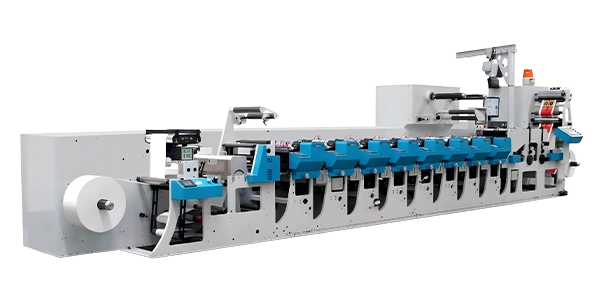
Its modular design is the biggest structural highlight. Enterprises can freely increase or decrease printing color groups, and integrate post-printing processing modules including laminating, varnishing, cold foil stamping, die-cutting, slitting, and rewinding on the same production line. This realizes one-pass printing and full converting, eliminating secondary material handling and positioning errors. Each printing unit operates relatively independently, with independent tension control for each station, making structural adjustment and daily maintenance extremely convenient. For a detailed overview of available inline configurations, explore our flexo printing machine product series.
1.2 CI Flexo Printing Machine
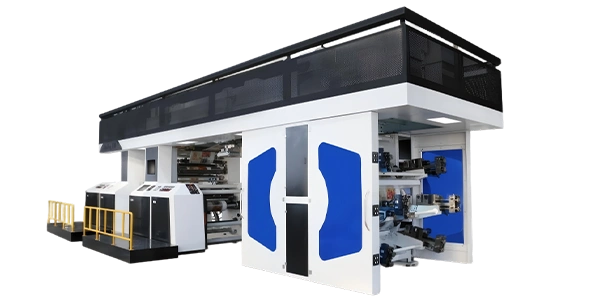
The CI flexo press adopts a central large impression cylinder core structure, which is the iconic design of high-end flexo printing. All color printing units are evenly distributed around a single super-large diameter central impression drum. During operation, the printing substrate is tightly wrapped on the central drum at a fixed tension, and all color groups complete overlay printing on the same impression cylinder in sequence.
Different from the discrete structure of inline presses, the CI model realizes one-time positioning and multi-color overlay printing. The ultra-large central drum provides stable and uninterrupted support for the web throughout the entire printing process, completely avoiding web jitter, stretching, and position deviation caused by multi-station transmission. The whole machine features integrated tension control and synchronous servo drive, with all printing units running around the central drum, forming a highly integrated and stable printing system.
2. Core Performance Differences: Print Quality & Registration Accuracy
Print registration accuracy is the key indicator distinguishing high-end and ordinary flexo presses, and it is also the biggest performance gap between inline and CI flexo machines, especially for multi-color fine printing jobs.
2.1 CI Flexo: Industry Benchmark for High-Precision Printing
Benefiting from the single central drum positioning design, the substrate has no floating displacement during the entire multi-color printing process. The fixed wrapping angle and stable tension completely eliminate cumulative registration errors generated by multi-station transmission of inline machines. Standard high-end CI flexo presses can achieve ±0.05mm ultra-fine registration accuracy, fully meeting the printing requirements of complex patterns, gradient colors, fine lines, and small text.
In addition, the central drum's constant temperature control system ensures stable substrate flatness, effectively solving printing defects such as color shift, ghosting, and uneven ink layering easily occur on thin and stretchable materials. It is the preferred equipment for high-standard packaging such as food, pharmaceutical, and cosmetic flexible films.
2.2 Inline Flexo: Stable Standard Printing for Diversified Jobs
Inline flexo presses rely on multi-station independent transmission, and subtle web stretching and jitter will inevitably occur during the repeated transmission process between units, resulting in cumulative registration errors. Its conventional registration accuracy is about ±0.1mm to ±0.2mm, which is slightly lower than CI presses. However, with the upgrade of full-servo automatic registration system and high-precision tension control technology, modern high-end inline flexo machines have greatly narrowed the accuracy gap, fully meeting the printing standards of most labels, stickers, and ordinary flexible packaging products.
It is worth noting that inline flexo machines have unique advantages in double-sided printing. The independent station structure can freely adjust the printing angle and process of the front and back sides, realizing synchronous double-sided multi-color printing, which is difficult for integrated CI flexo presses to achieve efficiently.
3. Substrate Adaptability & Application Scenario Differentiation
Due to structural and performance differences, the two types of equipment form completely differentiated application scenarios, covering low-end to high-end, short-run to mass production markets respectively.
3.1 Inline Flexo Machine: Diversified & Multi-Functional Production
Inline flexo presses excel in narrow-web printing and integrated converting production, with extremely strong substrate compatibility. They are suitable for various thin and thick materials including self-adhesive labels, trademark stickers, paper tags, plastic films, aluminum foil, and non-woven fabrics. Relying on modular expandability, they support one-stop production of printing + lamination + die-cutting + slitting + rewinding, which is extremely suitable for personalized, small-batch, and multi-order conversion jobs.
Core application scenarios: self-adhesive label printing, commodity trademark printing, clothing wash labels, small-batch flexible packaging, paper product printing, and special material customized printing. For label converters with frequent order switching and diverse product types, inline flexo is the most cost-effective production solution.
3.2 CI Flexo Machine: High-Precision & Mass Packaging Production
CI flexo presses are tailored for wide-web, high-speed, and high-precision flexible packaging mass production. The stable central drum structure can perfectly adapt to easily stretchable thin materials such as PE, PP, PET, and BOPP films, which are widely used in food packaging, beverage packaging, pharmaceutical packaging, and daily chemical packaging. Its excellent color overlay effect and consistent printing quality ensure no color difference or pattern deviation in batch products.
Core application scenarios: food plastic film packaging, pharmaceutical sterile packaging, cosmetic flexible packaging, large-batch roll-to-roll packaging printing, and high-standard multi-color overlay printing. It is the standard equipment for medium and large packaging printing enterprises focusing on mass orders. For tailored recommendations based on your application, explore our flexo printing and converting solutions page.
4. Production Efficiency, Cost & Operation Difference
In actual factory operation, equipment procurement cost, changeover efficiency, energy consumption, and maintenance cost directly determine the long-term profit margin of the production line.
4.1 Equipment Investment & Floor Space
Inline flexo machines feature a compact linear structure, lower overall procurement cost, and smaller floor space. The modular design allows phased configuration according to production demands, reducing early investment pressure. CI flexo presses have complex integrated structure, high manufacturing precision requirements, and higher procurement and installation costs, requiring larger factory space and higher foundation installation standards.
4.2 Order Changeover & Mass Production Efficiency
Inline flexo supports rapid order switching. The independent unit design simplifies plate changing, ink changing, and parameter adjustment, with extremely short startup preparation time, making it efficient for small and medium-batch diversified orders. CI flexo presses have complicated debugging procedures for new orders and long startup time, but they run stably at high speed in mass continuous production, with lower unit product loss and higher comprehensive mass production efficiency.
4.3 Daily Maintenance & Operating Cost
The discrete modular structure of inline flexo makes daily maintenance and parts replacement more convenient, with low maintenance threshold and cost. CI flexo has highly integrated mechanical and electrical systems, requiring professional technical personnel for daily debugging and maintenance, with relatively higher long-term operating costs.
5. How to Choose: Inline Flexo or CI Flexo?
After sorting out the core differences, enterprises can select equipment according to their own market positioning and order characteristics:
Choose Inline Flexo Machine if you: Focus on label and narrow-web packaging business, have diverse order types, frequent order switching, more small and medium-batch customized jobs, need integrated printing and converting functions, and have limited equipment investment budget.
Choose CI Flexo Machine if you: Focus on high-end flexible packaging mass production, mainly undertake large-batch film packaging orders, have strict requirements on printing precision and color consistency, and pursue long-term high-efficiency and low-loss batch production.
To understand how the CI architecture compares with other press types in more detail, read our in-depth comparison on CI Flexo vs Stack Flexo.
6. Conclusion
There is no absolute superiority or inferiority between Inline Flexo and CI Flexo machines, only suitability for different production scenarios. Inline flexo relies on flexible modularity, diversified functions, and cost advantages to become the mainstream equipment for label and customized converting industries. CI flexo relies on ultra-high printing precision, stable mass production performance, and excellent material adaptability to occupy the high-end flexible packaging market.
With the upgrading of flexographic printing technology, modern full-servo inline flexo machines are constantly improving in precision and stability, while CI flexo machines are also optimizing rapid changeover functions to adapt to market diversification. Choosing matched printing equipment according to enterprise business positioning is the key to improving production efficiency, optimizing product quality, and enhancing market competitiveness.
Related Reading
-
CI Flexo vs Stack Flexo: Which Printing Machine Should You Choose?
-
Key Flexo Printing Applications in Packaging & Labels
-
Inline Flexo Printing Machines for Label Production