

 Home
Home


For further details, please contact us.
Contact Us
In the modern packaging and converting industries, selecting the right flexographic printing press is a pivotal capital investment. As consumer demand for high-definition graphics, sustainable materials, and faster delivery times escalates, converters must carefully evaluate their machinery architecture to align with production targets.
Two of the most prominent flexographic press configurations on the market are the Central Impression (CI) Flexo Press and the Stack Flexo Press. While both utilize flexible photopolymer plates, low-viscosity inks, and anilox metering rollers to transfer ink onto a moving web, their structural engineering, web handling mechanisms, and operational capabilities differ significantly.
This comprehensive guide presents an in-depth technical comparison between CI Flexo and Stack Flexo presses—examining structural design, technical parameters, substrate compatibility, and process versatility—to help you determine which equipment best fits your packaging manufacturing needs. For a broader view of flexographic printing applications across industries, explore our solutions page.
1、Understanding the Structural & Architectural Differences
The primary distinction between a CI Flexo press and a Stack Flexo press lies in how the substrate is supported and transported across each printing color station.
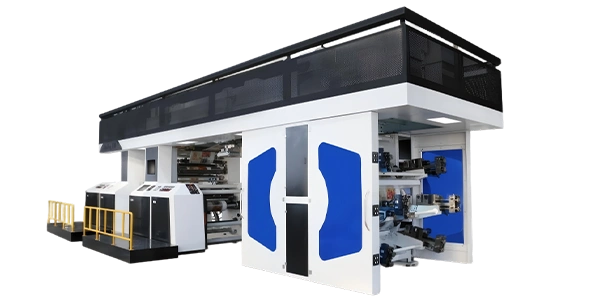
Central Impression (CI) Architecture
-
In a CI Flexo press, all printing decks (typically 4, 6, or 8 colors) are arranged in an arc around a single, high-precision Central Impression Cylinder (often built on a massive 100 mm cast-iron frame for thermal and mechanical stability).
-
As the web enters the press, it is clamped firmly onto the surface of this large central drum and travels around it continuously. Because the substrate remains fully supported by the drum surface throughout the entire printing pass, web tension remains uniform across all color stations, virtually eliminating stretching, thermal expansion, or web-flutter issues.
Stack Flexo Architecture
-
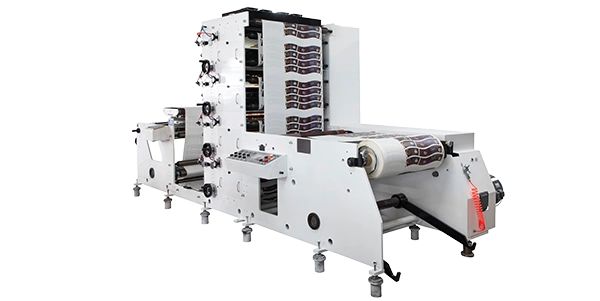
In contrast, a Stack Flexo press features individual printing stations stacked vertically on one or both sides of the main frame. Each printing station contains its own plate cylinder, anilox roller, doctor blade system, and impression cylinder.
-
The web travels upward or downward through the stack, spanning unsupported gaps between successive printing decks. Because each color unit operates independently, operators can disengage unused decks, perform setup changes on idle units while running a job, or configure complex multi-process paths.
2、Technical Specifications Comparison: CI Flexo vs Stack Flexo
To understand how these structural differences translate into operational performance, review the comparative technical specification matrix below:
| Feature / Technical Parameter | High-Speed CI Flexo Press | RY Series Stack Flexo Press |
|---|---|---|
| Structural Design | Single Central Impression Cylinder | Vertically Stacked Independent Decks |
| Mechanical Speed | 50 to 350 m/min | Up to 120–150 m/min |
| Printing Color Options | 4 / 6 / 8 Colors | 1 to 9 Colors |
| Maximum Web Width | 850 / 1050 / 1250 / 1450 / 1650 mm | 850 / 950 / 1050 / 1150 / 1250 mm |
| Maximum Printing Width | 800 / 1000 / 1200 / 1400 / 1600 mm | 840 to 1240 mm |
| Printing Repeat Length | 340 to 1000 mm | 180.975 to 450.85 mm / 222.25 to 600.075 mm |
| Registration Accuracy | ±0.10 mm (High stability on thin film) | ±0.10 mm (High stability on paper/board) |
| Color Register Control | Electric Registration Adjustment | 360° Weekly Alignment / Manual/Electric |
| Anilox Roller | Precision Ceramic Anilox Rollers | Ceramic Anilox Rollers |
| Ink Metering System | Enclosed Doctor Blade Chambers | Metering / Enclosed Doctor Blade |
| Plate-Cylinder Locking | Hydraulic Plate-Cylinder Locking | Mechanical / Pneumatic Locking |
| Main Frame Rigidity | 100 mm Cast-Iron Frame (Grade 5 Gear) | Heavy-Duty Stack Frame |
| Drying System | 5 m Overhead High-Efficiency Drying Oven | IR / Hot Air / UV / LED UV Systems |
| Compatible Ink Types | Water-Based, Solvent-Based | Water-Based, Solvent-Based, UV, LED UV |
| Unwind/Rewind Roll Diameter | Up to 800 mm (Opt. Auto Roll Changing) | 600 / 1000 mm (Opt. Turret Rewind) |
3、Key Performance Advantages & Engineering Highlights
3.1. High-Speed CI Flexo Printing Machine: Precision for Stretchable Materials
-
The CI Flexo press is designed for converter operations that demand maximum speed, continuous run-time, and ultra-precise registration on heat- or tension-sensitive substrates.
-
Uncompromising Registration Stability: Because the substrate never leaves the central drum during the ink transfer phase, registration variations caused by web stretch are controlled. This allows the press to achieve ±0.10 mm registration accuracy even at speeds up to 300 m/min.
-
Hydraulic Plate-Cylinder Locking: Hydraulic clamping mechanisms secure the plate cylinders rigidly in place, damping mechanical vibrations and guaranteeing repeatable setup conditions across shift changes.
-
Controlled Ink Transfer: Enclosed doctor blade chambers paired with laser-engraved ceramic anilox rollers maintain consistent ink viscosity and laydown. This is critical when utilizing water-based flexographic inks for food and medical packaging.
-
Short Web Path & Reduced Waste: The compact web arrangement around the central drum shortens the total substrate threading length, drastically minimizing startup waste and material loss during job changeovers.
-
Overhead 5-Meter Drying Oven: High-velocity 5 m drying tunnels efficiently remove ink solvents or water moisture at elevated production speeds before web rewinding.
-
Non-Stop Productivity: With optional automatic unwind and rewind roll changers, operators can perform fly-splicing without stopping the press, making it ideal for high-volume, long-run packaging jobs.
3.2、 Stack Flexo Printing Machine: Modular Versatility & Process Integration
The Stack Flexo press excels in multi-substrate flexibility, rapid color deck configuration, and seamless inline converting integration.
-
Independent Unit Operation: Each color deck can be engaged or disengaged independently. Operators can run 2-color or 4-color jobs on an 8-color stack press without running idle stations, reducing roller wear and setup times.
-
360° Weekly Alignment & Micro-Adjustment: Individual printing decks feature 360-degree circumferential register controls, allowing precise manual or motorized fine-tuning during setup.
-
Multi-Curing Technology: Stack presses can easily accommodate specialized drying systems—including Infrared (IR), Hot Air, UV, and LED UV modules—allowing converters to switch between water-based, solvent-based, and radiation-curable UV/LED inks.
-
Inline Converting & Post-Print Processing: The open structure of the stack layout makes it easy to integrate value-added processes inline, including:
-
Back-side printing via web turning units
-
In-line varnishing and surface coating
-
Slitting, sheeting, and conveyor delivery
-
Turret rewinding for continuous output
-
Automation Features: Modern RY-series stack presses incorporate imported frequency main drives, PLC touch-screen interfaces, automatic unwind tension controllers, and ultrasonic web guides for automated lateral deviation correction.
4、Substrate Compatibility & Application Analysis
Choosing between CI and Stack flexo presses often comes down to the physical properties of the substrate you plan to print.
4.1、Ideal Applications for CI Flexo
-
Thin Flexible Films (PE, BOPP, PET, PVC): Extruded polymer films stretch easily when pulled under high tension or exposed to heat. The continuous support of the Central Impression cylinder prevents material elongation, making CI flexo the standard for primary flexible packaging.
-
Food & Beverage Packaging: Form-fill-seal (FFS) pouches, bakery bags, snack packaging, and sanitary overwraps that demand high graphic fidelity and precise color reproduction.
-
Medical & Hygienic Products: Sterile barrier packaging, breathable films, and nonwoven backsheets for personal care items.
-
Long-Run Commercial Converting: Operations running tens of thousands of meters per job where high speed (300 m/min) and continuous roll-changing maximize profitability.
4.2、Ideal Applications for Stack Flexo
-
Paper & Paperboard Packaging: Heavy paper, thermal paper, paper cups, paper bags, and folding carton stock possess high tensile strength and do not stretch under tension. They feed cleanly through vertical stack configurations.
-
Pressure-Sensitive & Self-Adhesive Labels: High-grade stickers and prime labels requiring inline UV curing, rotary die-cutting, varnishing, or reverse printing.
-
Multi-Process Specialty Packaging: Applications requiring back-side printing (e.g., promotional terms or instruction labels) or inline sheeting/slitting in a single pass.
-
Short-to-Medium Run Jobs & Frequent Job Changes: Businesses with diverse product lines that require quick color deck changes, reduced ink usage on small batches, or frequent changes in web width.
5、Comparative Decision Matrix: How to Choose
When deciding between a High-Speed CI Flexo Press and a Stack Flexo Press, evaluate your plant's production profile against the following criteria:
5.1、Choose a High-Speed CI Flexo Press if:
-
Your primary material is thin, stretchable film: You specialize in PE, BOPP, or thin laminates where tension control is critical to preventing registration drift.
-
Graphic accuracy is your top priority: You produce fine screen counts, intricate color overlays, or brand packaging requiring strict ±0.10 mm registration stability across 6 or 8 colors.
-
You operate long production runs: You need high mechanical throughput (300 m/min), automatic roll changing, and low material waste during continuous runs.
-
You prioritize energy efficiency and short web paths: You want to minimize startup scrap and optimize floor space with a compact central drum layout.
5.2、Choose a Stack Flexo Press if:
-
Your product portfolio focuses on paper, board, or labels: You manufacture paper cups, thermal paper rolls, self-adhesive stickers, or laminated paper bags.
-
You require inline finishing: You need to perform back-side printing, inline varnishing, UV/LED curing, slitting, or sheeting in a single continuous pass.
-
You need variable color deck flexibility: You frequently run 1, 2, or 3-color jobs alongside full 6- or 8-color work and want the ability to disengage unused printing decks.
-
You manage short-to-medium jobs with varied budgets: You want a versatile, cost-effective press that handles diverse substrates with easy access for manual adjustments and rapid wash-ups.
6、Conclusion
-
Both Central Impression (CI) Flexo and Stack Flexo presses play vital roles in modern packaging production.
-
The CI Flexo Press represents the gold standard for high-speed, high-precision film converting, offering unmatched registration accuracy, low substrate waste, and stable tension control on delicate materials.
-
Meanwhile, the Stack Flexo Press offers modular flexibility, multi-process versatility, and inline finishing capabilities that make it the machine of choice for paper, label, and specialized packaging converters.
-
By carefully matching your substrate properties, speed requirements, graphic complexity, and inline processing needs to the right equipment architecture, you can optimize capital expenditure, streamline plant efficiency, and achieve maximum return on investment. For further guidance on specific applications, explore our flexo printing solutions or read our detailed comparison on flexo printing vs rotogravure to understand broader technology choices.